
Home » Living with arthritis » Treatment & Care » Secukinumab
Secukinumab
Quick links
- What is secukinumab?
- What benefit can you expect from your treatment?
- Stopping secukinumab
- How will you be checked while on secukinumab?
- How is secukinumab given?
- If you miss an injection
- What is the dosage?
- Can other arthritis medicines be taken with secukinumab?
- Are there any side effects?
- What precautions are necessary?
- How to store secukinumab
- Disposal
- Important things to remember
What is secukinumab?
Secukinumab (brand name: Cosentyx®) is a medicine used to treat adults with psoriatic arthritis, a type of joint inflammation that often occurs with the skin condition called psoriasis. Secukinumab is also used to treat adults with moderate to severe chronic (long lasting) plaque psoriasis.
Secukinumab is also used to treat adults with axial spondyloarthritis, including ankylosing spondylitis, a condition which causes inflammation in the spinal joints, resulting in pain and stiffness in the spine.
Secukinumab works by blocking a protein called IL17A that drives inflammation and can cause joint pain and stiffness in people with psoriatic arthritis and axial spondyloarthritis. This means secukinumab can reduce the inflammation and the pain and stiffness caused by too much IL-17A.
What benefit can you expect from your treatment?
It usually takes a few weeks to notice joint swelling, pain and stiffness getting better.
Stopping secukinumab
If you stop or delay your secukinumab treatment, your condition may get worse. Continue your treatment unless your rheumatologist tells you to stop or unless you get side effects (see Side effects).
If you stop secukinumab for any reason, you must contact your rheumatologist. If you don’t, your treatment may stop being subsidised by Medicare.
How will you be checked while on secukinumab?
Medicines like secukinumab are very expensive, but Medicare usually helps cover the cost if you meet certain conditions.
- Secukinumab can only be given if your disease is active and usual treatments have not worked.
- The treatment will continue only if it helps you, which is checked between 12 and 16 weeks after starting.
- You will need blood tests during treatment to check for side effects and see if it’s working.
- How often you need blood tests depends on other medicines you take and any other illnesses you have. Your rheumatologist will tell you this.
How is secukinumab given?
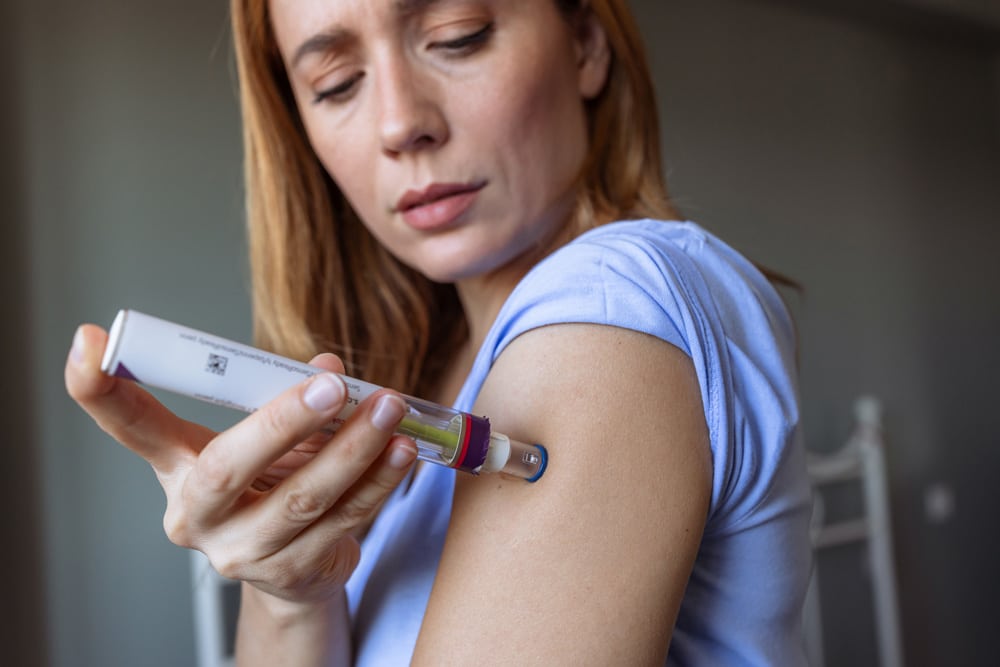
Secukinumab is injected just under the skin of the thigh or belly. It is best to avoid (if possible) any areas of skin affected by psoriasis. The prefilled autoinjector or syringe should be taken out of the fridge 30 minutes before injecting so it can reach room temperature. Do not shake or freeze it. It can be injected by your doctor, nurse, carer, or by you.
If injecting yourself, be sure to follow the detailed instructions carefully to ensure the best response. It is important to change the injection site each time.
If you miss an injection
Give the next injection as soon as you remember and continue to use it as you normally would. Do not inject a double dose to make up for a missed dose. If you have missed more than one dose or are not sure what to do, check with your doctor or pharmacist.
What is the dosage?
Secukinumab comes in a pre-filled syringe or pen which has 150mg or 300mg of medicine. Depending on your arthritis symptoms and, for some people, your psoriasis your doctor might choose one or the other strength. Either way, the usual dose is to have your injections each week for the first 5 weeks of treatment, then once every 4 weeks after that.
Can other arthritis medicines be taken with secukinumab?
This medicine may be used alone or with other arthritis medicines including:
- Other Disease Modifying Anti Rheumatic Drugs (DMARDs) such as methotrexate.
- Steroid medicines such as prednisolone or cortisone injections into the joint.
- Anti-inflammatory medicines (NSAIDs) such as naproxen (Naprosyn®) or ibuprofen (Brufen®, Nurofen®).
- Pain medicines such as paracetamol.
Are there any side effects?
You might experience side effects with your treatment. Tell your doctor if you notice side effects that you think are caused by this medicine. Many side effects disappear when secukinumab treatment is stopped.
Most common possible side effects
- You may have more mild upper respiratory tract infections (common cold, sinus infections), nausea, diarrhoea, cough, and fever.
- Infections may need treatment and secukinumab may need to be stopped for a while during an infection, so it is important to contact your doctor for advice.
Less common or rare possible side effects
There are some rare but sometimes serious side effects with secukinumab including:
- Thrush, athlete’s foot and other fungal skin infections, your doctor will do blood tests to monitor your white cells (which fight infection) which can rarely become low on secukinumab.
- Menstrual disorders including period pain and irregular periods.
- Rarely, secukinumab can cause an allergic reaction with itchy, red skin rash, chest tightness and trouble swallowing or breathing.
- Tell your doctor or go to the hospital immediately if you have an allergic reaction as you need urgent medical attention.
- Flare ups of inflammatory bowel disease including Crohn’s disease or ulcerative colitis: can occur while being treated with secukinumab.
If you have these conditions, your doctor should talk to you before starting this medicine, so you know the risks and to tell your doctor if you get tummy pain or diarrhoea.
What precautions are necessary?
Infections
If you have an active infection, treatment with secukinumab will not be started until the infection is treated.
Before starting secukinumab, your rheumatologist may screen you for some infections, including hepatitis B and C, HIV and tuberculosis. In most
people this is done by asking you about possible past exposure to these infections and with a blood test, but some rheumatologists may choose to do a
chest X-ray as well.
Use with other medicines
Secukinumab can affect and be affected by other medicines. You should tell all your doctors about all medicines you are taking or plan to take. This includes over the counter or herbal/natural medicines.
Use with phototherapy
Secukinumab should not be used while having light therapy (PUVA) for psoriasis.
Vaccines
- While being treated with secukinumab you should not have ‘live’ vaccines such as: MMR (measles, mumps and rubella), varicella vaccines (Chicken pox/Shingles), OPV (oral polio virus), BCG (Bacillus Calmette Guerin), Japanese Encephalitis or Yellow Fever. Talk with your rheumatologist before receiving any vaccines.
- Pneumococcal vaccines and the yearly seasonal flu vaccinations are encouraged.
- For more information on vaccination including the COVID-19 vaccination click HERE
Surgery
If you need surgery for any reason, you should discuss this with your rheumatologist as some people might need to stop taking secukinumab before surgery.
Alcohol
You may drink alcohol while taking secukinumab.
However, if you are also taking methotrexate, you should be cautious about how much alcohol you drink.
Pregnancy, breastfeeding and fertility
- We don’t know how secukinumab can affect an unborn baby.
- If you are pregnant or thinking about having a child, you should discuss this with your rheumatologist before beginning this medicine.
- Women who are able to be pregnant should use effective birth control contraception) during treatment
- If you have used secukinumab during your pregnancy, you should check with your doctor before vaccinations are given to your baby.
Some vaccines cannot be given to the newborn baby if you were treated with secukinumab while you were pregnant. - No studies have looked at secukinumab in breastmilk, but it is unlikely to be harmful to a newborn baby. Women who are breastfeeding should talk to their doctor about whether or not to use secukinumab.
How to store secukinumab
- Store secukinumab in the fridge, between 2 and 8°C. Do not freeze. If needed secukinumab may be stored out of the fridge once, for up to 4 days at room temperature, not above 30°C. Do not return to the fridge once it has reached room
temperature. - Keep the pens or syringes in the original carton to protect them from light until the time of use.
- Keep all medicines out of reach of children.
Disposal
- After injecting secukinumab, the used syringes or pens should be placed in a puncture-resistant container, like a sharps container. Dispose of your sharps container according to your state or local council regulations. If unsure how to dispose of your sharps container, ask your pharmacist. For more information, see the ‘Safe Disposal of Sharps’ guide.
- If your doctor tells you to stop using secukinumab, or the expiry date has passed, ask your pharmacist what to do with the leftover medicine.
Important things to remember
- You must see your rheumatologist regularly to make sure the treatment is working and check for possible side effects.
- You should have regular blood tests as suggested by your rheumatologist.
- It is important to tell your rheumatologist if you have a new serious illness such as a serious infection, cancer or heart failure etc.
- Remember to change the injection site each time secukinumab is injected.
- If you are worried about any side effects, you should contact your rheumatologist as soon as possible.
- You must tell your rheumatologist if you want to stop secukinumab. If you don’t, your treatment may no longer be funded.
- Let your rheumatologist know if you plan to become pregnant.
- If you need a vaccination, tell your doctor you are being treated with secukinumab before you have the vaccination. Some vaccines cannot be given while on secukinumab.
This Information Sheet has been prepared using materials obtained from various sources which have been reviewed by the Australian Rheumatology Association (ARA). It contains general information only and does not contain a complete or definitive statement of all possible uses, actions, precautions, side effects or interactions of the medicines referenced. This information is not intended as medical advice for individual conditions nor for making an individual assessment of the risks and benefits of taking a particular medicine.Decisions regarding the assessment and treatment of patients are the sole responsibility of the treating medical professional, exercising their own clinical judgment and taking into account all of the circumstances and the medical history of the individual patient.
ARA has used all reasonable endeavours to ensure the information on which this Information Sheet is based is accurate and up to date.
However, the ARA accepts no responsibility or liability for the accuracy, currency, reliability and/or completeness of the information contained in this Information Sheet. To the maximum extent permitted by law, the ARA expressly disclaims any liability for any injury, loss, harm or damage arising from or in connection with use of and reliance on the information contained in this Information Sheet.
This information sheet is copyright and may be reproduced in its entirety but may not be altered without prior written permission from the ARA.
Revised in June 2026