
Home » Living with arthritis » Treatment & Care » Self-injecting low dose methotrexate for the treatment of arthritis
Self-injecting low dose methotrexate for the treatment of arthritis
(Brand names: Trexject)
Quick links
- How is methotrexate supplied?
- Can I inject methotrexate by myself?
- How often will I need an injection?
- Is the injection painful?
- How should I store the methotrexate?
- What other equipment do I need?
- How much of the liquid should I draw up and inject?
- How do I do the injection?
- General notes
- For more information
This information is useful if your doctor has recommended injections of methotrexate to improve its effectiveness or minimise side effects. It gives information about how you, or a friend or family member, can safely inject methotrexate, the steps to follow and the equipment you will need.
For general information on methotrexate, refer to the ‘Methotrexate’ patient information sheet on the Australian Rheumatology Association (ARA) website.
How is methotrexate supplied?
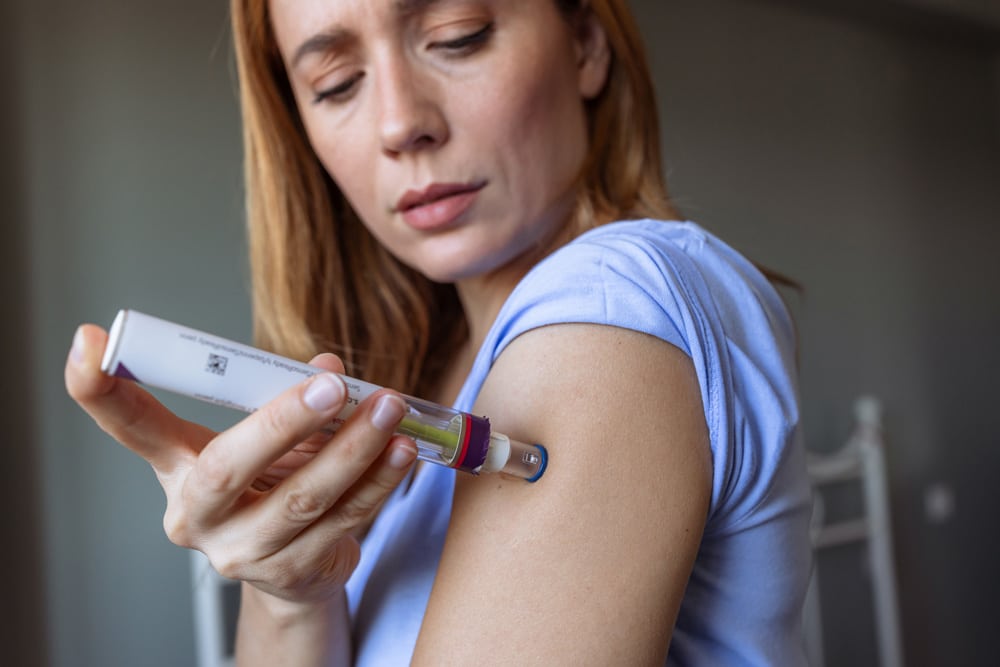
Injectable methotrexate is available either as prefilled syringes (Trexject) or in a vial.
Can I inject methotrexate by myself?
Yes, methotrexate is most conveniently injected by yourself, a friend or family member. If necessary, your GP (or their nurse) may do it for you. You can arrange for them to help you with your first injection/s until you are confident to do it yourself.
How often will I need an injection?
Injections of methotrexate are given once a week ONLY.
Is the injection painful?
The injection is relatively painless as it uses a fine needle that is inserted just under the skin (subcutaneous). It is often described as the feeling of a slight pinprick and only lasts for a few seconds.
How should I store the methotrexate?
It does not need to be kept in the fridge but should be stored away from heat or light where the temperature stays below 25°C (in a cool pantry or cupboard, not on a windowsill). Ensure it is stored out of the reach of children.
Injectable methotrexate in a vial
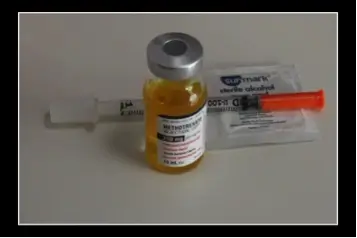
Injectable methotrexate is supplied in a vial with clear yellow liquid as 50mg in 2ml. Usually five vials are provided on each prescription.
What other equipment do I need?
When using the Trexject syringes you will need a sharps container for disposing of the syringe after the injection (the company for Trexject can also provide this or it can be obtained from pharmacies). You may also obtain alcohol swabs to clean the skin before injecting.
If using the vials as pictured below, you will also need insulin syringes (1ml) which have a fine needle and are recommended for methotrexate injections. These syringes have numbers written along their side to help you draw up the correct amount of liquid for the dose of methotrexate you are taking. Syringes can be bought in bags of 10 at the pharmacy.
How much of the liquid should I draw up and inject?
The following table tells you how much liquid to draw up for different doses and what number this is on an insulin syringe. Your doctor will usually prescribe a dose between 10 and 25mg. So, for example if your dose is 25mg of methotrexate
you will need to draw up 1.0ml. 1.0ml is the number 100 on an insulin syringe.
| Methotrexate dose | Amount of liquid to draw up | Number on insulin syringe |
| 10mg | 0.4ml | 40 |
| 15mg | 0.6ml | 60 |
| 20mg | 0.8ml | 80 |
| 25mg | 1.0ml | 100 |
If you are unsure about your dose or how much liquid you need to inject, check with your GP, pharmacist or rheumatologist before injecting.
How do I do the injection?
- Wash your hands with soap and water.
- The area of your skin that you are injecting should be clean (for example after a shower) or washed with soap and water. If you prefer you can wipe it with an alcohol swab and allow 60 seconds to dry but it is not required.
- Remove the protective cover from the methotrexate vial. If it has been used before rub the rubber top with an alcohol swab and allow 60 seconds to dry.
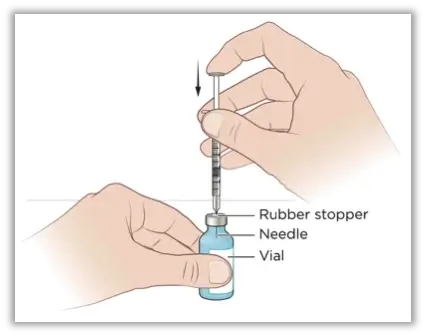
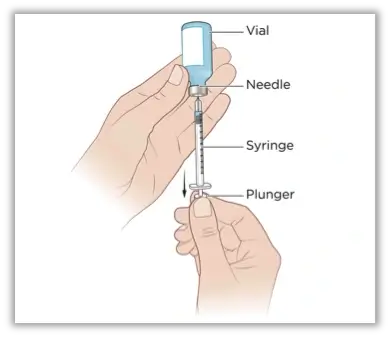
- Remove the cap of the needle and insert the needle through the rubber stopper of the vial. Push the plunger down to the end to push out any air from the syringe. Make sure the needle tip is in the liquid then pull the plunger back and draw up the required quantity of methotrexate liquid (note, it is not harmful if there is a small air pocket in the syringe and you accidentally inject a little air with the solution under the skin).
- Using two fingers, pinch up a fold of skin and push the needle into the skin, like a dart, at an angle of approximately 90° (right angle). If you are injecting yourself, the lower abdomen or the upper thighs are probably easiest as shown in the figure below. Never inject into skin that is tender, bruised, red, hard, scarred or where you have stretch marks. If you have psoriasis, you should avoid injecting directly into any raised, thick, red or scaly skin patches or lesions.
- Push the plunger on the syringe all the way down to inject the methotrexate. Pull the needle straight out and apply some pressure to the skin with a cotton wool ball for a few seconds. Do not worry if there is a small amount of leakage or you get methotrexate on your skin as it is not absorbed – just wash your hands. Slight bleeding or bruising at the injection site is normal and the bleeding should ease quickly if you apply pressure with a cotton wool ball or tissue or cover with a band aid.
- Put the syringe and any old methotrexate vials, swabs or cotton wool balls into your sharps container. Wash your handsRelease the skin and push the plunger on the syringe all the way down to inject the methotrexate. Pull the needle straight out and apply some pressure to the skin with a cotton wool ball for a few seconds. Do not worry if there is a small amount of leakage or you get methotrexate on your skin as it is not absorbed – just wash your hands. Slight bleeding or bruising at the injection site is normal and the bleeding should ease quickly if you apply pressure with a cotton wool ball or tissue.
How do I administer the TREXJECT injection?
- Wash your hands with soap and water.
- The area of your skin that you are injecting should be clean (for example after a shower) or wash with soap and water. If you prefer you can wipe it with an alcohol swab and allow 60 seconds to dry but it is not required.
- Remove the pre-filled syringe from the packaging at room temperature. Before use, check the TREXJECT syringe for visual defects (or cracks). Trexject syringes do contain sodium chloride, sodium hydroxide and water and so warming the syringe in your hands before injection may help to prevent any stinging.
- Choose an injection site on your lower abdomen or upper thigh as shown in the figure above and clean the area. Carefully remove the grey protective plastic cap by pulling it straight off the syringe. If the cap is very stiff, turn it slightly with a pulling movement.
Important: Do not touch the needle of the prefilled syringe. Note: Once you have removed the cap, perform the injection without delay. - Using two fingers, pinch up a fold of skin and quickly insert the needle into the skin at a 90- degree angle. Insert the needle fully into the fold of skin. Push the plunger down
completely to inject the liquid underneath your skin. Hold the skin securely until the injection is completed. Carefully pull the needle straight out and apply some pressure
to the skin with a cotton wool ball for a few seconds.
Never inject into skin that is tender, bruised, red, hard, scarred or where you have stretch marks. If you have psoriasis, you should avoid injecting directly into any raised, thick,
red or scaly skin patches or lesions. - Do not worry if there is a small amount of leakage or you get methotrexate on your skin as it is not absorbed – just wash your hands. Slight bleeding or bruising at the injection site is normal and the bleeding should ease quickly if you apply pressure with a cotton wool ball or tissue or cover with a band aid.
- Put the syringe, swabs or cotton wool balls into your sharps container. Wash your hands.
General notes
- Taking low-dose methotrexate (between 5mg and 25 mg) taken once each week for arthritis or other inflammatory chemotherapy. diseases is NOT chemotherapy.
- The needle and syringe should only be used once and then thrown away in the sharps container. Never re-use syringes or needles. DO NOT THROW ANY SYRINGES OR NEEDLES into the general rubbish or recycling.
- (For injectable methotrexate in a vial) – Since the methotrexate solution does not contain preservative, it is recommended that it is used once only. However, in some instances vials may be safely used more than once so you should discuss this with your doctor.
- When your sharps container is three quarters full, seal and return to the pharmacy where you buy your methotrexate.
- If you have forgotten to give yourself an injection at the right time, wait until your nominated day of the week occurs again and then have your weekly dose. DO NOT take a double dose to make up for the forgotten single dose. If you are given or have given yourself too much (overdose)
- If you are given too much methotrexate, you may experience some of the side effects listed in the methotrexate patient information sheet on the ARA website. You should let your doctor know as soon as possible.
If you are uncertain about anything, particularly the dose, make sure you check with your doctor first. - The syringes already have the set dose in the syringe, supplied as a pack of 4 (one month supply).
- It is available as syringes (Trexject) with set doses of 7.5mg/0.15mL, 10mg/0.2mL, 15mg/0.3mL, 20mg/0.4mL and 25mg/0.5mL
For more information
For further information on methotrexate ask your rheumatologist or see the ARA info sheet
This video also shows how to inject methotrexate safely.
This Information Sheet has been prepared using materials obtained from various sources which have been reviewed by the Australian Rheumatology Association (ARA). It contains general information only and does not contain a complete or definitive statement of all possible uses, actions, precautions, side effects or interactions of the medicines referenced. This information is not intended as medical advice for individual conditions nor for making an individual assessment of the risks and benefits of taking a particular medicine. Decisions regarding the assessment and treatment of patients are the sole responsibility of the treating medical professional, exercising their own clinical judgment and taking into account all of the circumstances and the medical history of the individual patient.
ARA has used all reasonable endeavours to ensure the information on which this Information Sheet is based is accurate and up to date. However, the ARA accepts no responsibility or liability for the accuracy, currency, reliability and/or completeness of the information contained in this Information Sheet. To the maximum extent permitted by law, the ARA expressly disclaims any liability for any injury, loss, harm or damage arising from or in connection with use of and reliance on the information contained in this Information Sheet.
This information sheet is copyright and may be reproduced in its entirety but may not be altered without prior written permission from the ARA.
Please consider the environment before printing this resource.
Page updated February 2026